Why It Costs $13,000 to Make a Safe Mortgage
By Peter Yoder. . 4 minute read.
Automated underwriting systems addressed credit risk, but misaligned liability structures transformed mortgage origination into an expensive compliance exercise.
It now costs more to manufacture a mortgage than the average American earns in two months. The Mortgage Bankers Association reports that originating a plain vanilla 30-year fixed loan averages $13,000, triple what it cost in 2005.
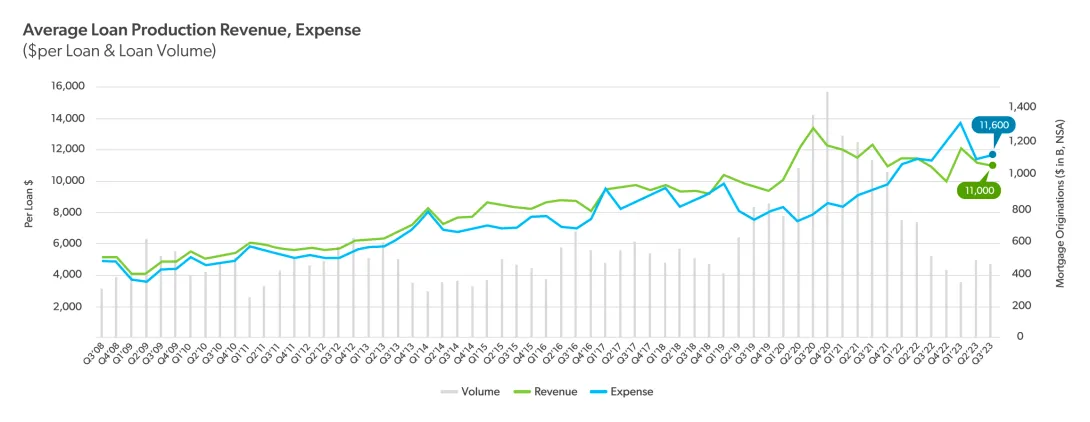
At the same time, mortgages themselves have never been safer. In 2010, more than one in ten was seriously delinquent. Today, it’s fewer than one in a hundred. By credit performance, mortgages are rock-solid. Yet the price of producing them keeps climbing.
After 2008, the mortgage stopped being about the borrower’s ability to pay and became about insulating lenders, servicers, and GSEs from liability in court years later.
When lenders sell mortgages to Fannie Mae or Freddie Mac, they certify that every detail follows the agencies’ rulebook: income calculated exactly their way, every debt disclosed, appraisals documented to spec, and all documents fresh at closing. After the crash, with taxpayers bailing them out, Fannie and Freddie began enforcing those promises with unusual intensity.
A borrower could be making every payment, but if a bank statement was stale or a bonus was counted wrong, the loan could be forced back on the lender. At one point, Fannie had nearly $20 billion in repurchase demands outstanding.
FHA loans face the same dynamic. After 2008, the Justice Department used the False Claims Act to treat even small paperwork mistakes as fraud, extracting billions from major banks like Wells Fargo and JPMorgan. The message was blunt: every FHA loan carried lawsuit risk.
Within a few years, the largest banks pulled back, and nonbanks filled the gap. Those lenders passed the compliance burden into pricing, so the very borrowers FHA was meant to help, first-time and lower-income buyers, faced higher costs and fewer options.
The overarching lesson for lenders was clear: defaults could be managed, but defects in the file would destroy you.
Lenders hired floors of staff whose only job was to re-verify documents. They tightened rules beyond what Fannie or Freddie required, raising credit-score floors and capping debt ratios to avoid borderline cases. They slowed the process to ensure nothing could be questioned later.
Even the automated underwriting systems, Desktop Underwriter at Fannie and Loan Product Advisor at Freddie, haven’t solved this. They can approve a loan instantly, but lenders still carry full liability for every document behind the inputs. A typo on a paystub or a stale bank statement can still trigger a buyback years later. The machine says “yes,” but the system forces lenders to behave as if it might someday say “no.”
That’s why mortgages cost $13,000 to produce. The expense isn’t in deciding whether families can pay. It’s in building a file so airtight it can survive a forensic audit years down the line.
For borrowers, this invisible tax is punishing. Higher origination costs roll into fees and interest rates. Families who should qualify are denied because their files aren’t bulletproof. Urban Institute estimates more than six million “missing mortgages” in the ten years after the crash; that is, loans that would have performed but were never made because lenders feared repurchase risk.
That helps explain why younger generations are locked out of ownership. For decades, home equity was the escalator into the middle class. Now the escalator is slowed by paperwork and fear. A system meant to protect investors has become one of the least visible contributors to America’s wealth gap.
The defect problem in U.S. mortgage lending is one of process design. Today, lenders face the same catastrophic repurchase risk whether a borrower misstates income by 50% or whether an underwriter transposes a digit on a paystub. The system conflates human error with true risk, and the result is a regime of overlays, higher costs, and credit pulled back from the margin.
We know this empirically. The Federal Housing Finance Agency’s own defect taxonomies show that data integrity and documentation errors, not borrower fraud, drive the majority of buybacks. Independent studies of automated asset and income verification tools, drawing data directly from payroll systems and depository institutions, demonstrate error-rate reductions on the order of 75% compared to manual document collection. The veracity of the data is not the issue; it is the liability framework that treats trivial clerical defects as though they are credit failures.
The remedy is straightforward but requires political will:
- Safe harbor should be mandated, universal, and automatic, not opt-in, not conditional, and not a proprietary GSE product. If the data comes directly from payroll, banks, or the IRS, liability should shift by law.
- Materiality thresholds. Repurchase should be limited to defects with measurable impact on repayment probability, not inconsequential clerical misses.
- Transparency. Fannie Mae and Freddie Mac should publish loan-level repurchase statistics, so overlays are calibrated to evidence rather than rumor.
This is not deregulation. By distinguishing between immaterial and material misrepresentation, the system can reward accuracy rather than ceremony. Until liability is tethered to the veracity of verified data, lenders will continue to operate defensively, layering costs and denying credit where it could be safely extended.
These changes would cut costs meaningfully and shift the system back toward its real job: expanding access to credit for families who can pay.
The $13,000 mortgage is not the price of credit. It’s the bill the middle class pays for a financial system afraid of its own shadow.