The Missing Middle Financing Failure
By Peter Yoder. . 8 minute read.
How mortgage underwriting suppresses America’s most affordable homeownership model.
In 2024, lenders denied one in three people who applied for a mortgage to buy a fourplex and live in it. They denied one in seven investors buying the same buildings.
The owner-occupants had every federal advantage the first-time-buyer system offers. The investors had none. The owner-occupants got worse results.
The disparity widens with each unit added:
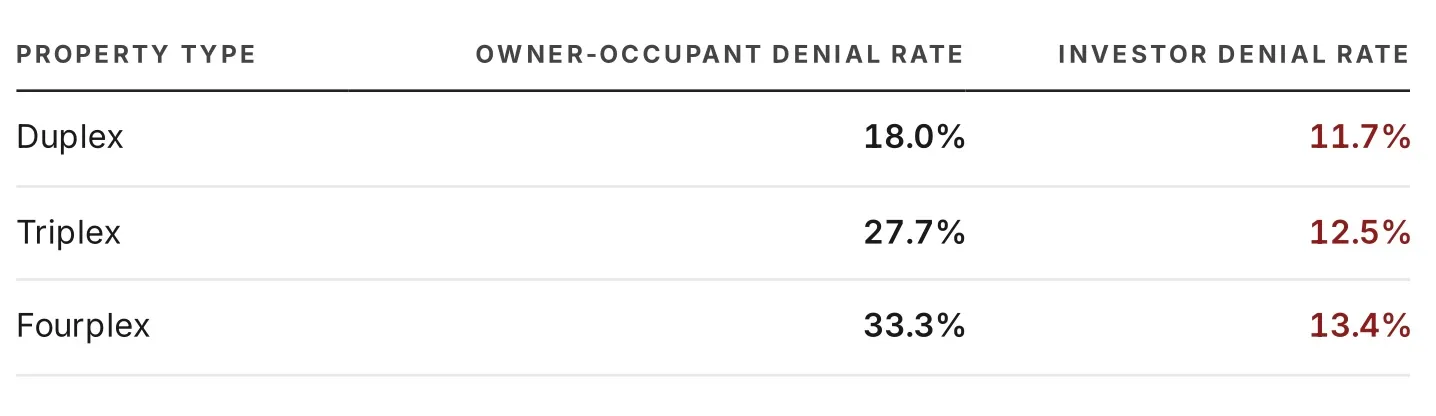
The investor rate barely moves with building size. The owner-occupant rate nearly doubles. If the buildings carried the risk, investor denials would scale with them. They do not. The rules treat the building as worse credit only when an owner-occupant lives in it. Owner-occupants are denied at 1.7 times the investor rate on the same buildings. The numbers come from the federal record of every mortgage application filed in the country.
The suppression
Two- to four-unit buildings make up 7% of America’s housing stock. Owner-occupants bought 50,149 of them in 2024, which is 1.45% of all purchase mortgages. Single-family purchases totaled roughly three million. If owner-occupant transactions tracked stock, the share would be closer to 13%. The shortfall is on the order of 400,000 buyers per year.
New construction peaked at 167,000 units in 1973 and has run near 12,000 a year since the financial crisis. Zoning explains why these buildings stopped being built. Zoning does not explain why the five million that already exist almost never trade to owner-occupants. We cannot upzone our way out of a financing problem.
The shortfall has no easy explanation. Inventory is not the problem: the buildings exist. Program design is not the problem: FHA, conventional, and VA all permit owner-occupied purchases in this typology on competitive terms. Demand is not the problem either. A fourplex on Cleveland’s north side listed at $485,000 costs its owner-occupant about $1,350 a month after rental income; matching that monthly cost with a Cleveland single-family home takes a $160,000 purchase price. A $799,000 Queens duplex carries a $3,500 monthly cost; the equivalent single-family payment requires a $440,000 house. Twice the asset, same monthly cost.
Capital is not the constraint either. In November 2023, Fannie Mae cut the required down payment on owner-occupied 2–4 unit homes from 15–25% to 5%, the largest concession in two decades. If down payment were the binding constraint, volume should have jumped. Originations went from 1.44% of purchase volume to 1.45%. Removing one barrier from a stack of five changed nothing observable in the data.
The mortgage system treats 2–4 unit owner-occupants as worse credit than investors on the same buildings. The result is the suppression of the most naturally affordable homeownership typology in the country.
Two rules drive most denials
Lenders report the reasons behind every denial. For 2024 owner-occupant denials in this segment, two reasons account for more than half of all reported codes: debt-to-income ratio, and insufficient collateral, which is almost always an appraisal problem. Both are agency policy. Both can be changed without legislation.
The income rule. When an owner-occupant buys a fourplex, Fannie Mae’s guidelines credit 75% of the gross rent as qualifying income, then count the full mortgage payment as debt. The rent is never netted against the payment. Run that through the standard 43% debt-to-income cap and a dollar of rent supports 32 cents of mortgage payment. Small multifamily buildings routinely run 60–75% operating margins with single-digit vacancy; the rule treats a building with an owner-occupant in it as if it performs at half its real margin.
An investor buying the same fourplex gets the opposite treatment: 75% of gross rent, minus the full payment. If the building cash flows, the mortgage falls out of the investor’s debt ratio entirely. The building is allowed to stand on its own income. The same rent stream is real cash flow when an investor owns the property and unreliable income when an owner-occupant owns it.
FHA borrowers on triplexes and fourplexes face a further gate: the self-sufficiency test. If 75% of the building’s gross rent does not cover the entire monthly payment, the loan is denied, regardless of the borrower’s income, credit, or reserves. A buyer earning $500,000 with perfect credit is denied if the appraiser’s rent estimate times 0.75 comes in $50 short. The test does not evaluate the borrower. It evaluates the building as a stand-alone investment property — the exact analysis an investor would run — then applies the result as a gate to an owner-occupant.
The appraisal spiral. Valuing a 2–4 unit property requires comparable sales and an income approach, and both depend on data that does not exist in most markets. Too few of these buildings trade to support the price through comps, so the valuation leans on the appraiser’s estimate of market rent, a number with no external check. There is no national database of small-multifamily rents the way the MLS provides sales comparables. A low appraisal triggers extra costs or kills the deal outright, and every killed deal means one fewer comparable sale and one fewer rent observation next year. The data problem compounds itself.
Smaller barriers stack on top: a rate surcharge of up to 1% keyed to unit count, and reserve requirements of six months of payments on a triplex or fourplex against two on a duplex. On a $3,500 payment, that is $21,000 in the bank after the down payment and closing costs. The down payment was cut to 5%. The cash requirement did not follow. The 1.7× denial ratio is the cumulative output of the stack.
The 2008 ghost
The counterargument: the agencies did not invent these rules. They wrote them in response to real losses on 2–4 unit loans during the financial crisis, and the rules are only stale if the underlying risk has changed.
The losses were real. The Urban Institute analyzed all 14 million Fannie Mae and Freddie Mac loans originated between 2000 and 2014. After controlling for credit score, down payment, and debt-to-income, 2–4 unit owner-occupied properties defaulted 23–29% more often than single-family homes, and foreclosure losses ran 58–63 cents on the dollar against 37. During that window, the agencies were right to price these buildings as worse credit.
The window is the point. That data covers the worst lending environment in modern American history, when stated-income loans were standard and verified rental income was rare. After the crisis, the agencies raised down payments to 20–25% and volume fell from 6–8% of agency production to under 3%. The borrowers who cleared the new gate looked nearly identical to single-family borrowers: 752 average credit score, 25% down against 17%. By the end of Urban’s own study window, tolerated losses on 2–4 unit loans had compressed to a range indistinguishable from single-family. Urban’s conclusion: these properties “have about the same risk as one-unit owner-occupied properties.”
FHA’s performance data confirms the shift. 2–4 unit FHA borrowers have missed fewer first payments than single-family borrowers every month since September 2013. Total past-due rates crossed below single-family around 2017 and stayed there. Serious delinquency began the period 4.2 points worse, crossed in early 2020, and has run better since: 5.14% against 6.30% in the current readings. One metric still favors single-family: foreclosure. But that gap has narrowed from 2.5× to 1.5×, and the absolute rate has collapsed from 4.5% to 0.69%.
The borrower who clears today’s underwriting is not the borrower who defaulted in 2008. The risk premium baked into the current rules — the income haircut, the self-sufficiency test, the rate surcharge, the elevated reserves — was calibrated to a loss profile that no longer exists. The data justifying it is fifteen years stale.
The agencies moved halfway
Two recent Fannie Mae announcements show the agencies recognize the rental-income problem and have the authority to fix it without legislation. The same announcements show how cautiously they are willing to move.
In October 2025, Fannie Mae allowed rental income from an accessory dwelling unit to count toward qualifying income on a single-family principal residence: one ADU only, capped at 30% of the borrower’s total qualifying income. In December 2025, it expanded collateral eligibility: a single-family property can now carry up to three ADUs.
Read together, the two announcements concede the argument and refuse to act on it. A single-family parcel with three ADUs — four functional dwelling units — is now fully insurable as collateral, but only one unit’s rent counts toward qualification. The asset side has moved. The cash flow side has not. The result is a buyer-selection effect: the only households who can close on these newly eligible properties are the ones that qualify on salary alone, which means, by definition, higher-income households. The agencies have done the easy part, acknowledging the buildings are sound, without doing the hard part, acknowledging the cash flow is bankable.
One more lever is already built. The new appraisal standard, mandatory for all submissions this November, collects granular rent data on multi-unit buildings with every transaction. The agencies are collecting it. They are not publishing it back to appraisers as a rent-comparable database, the way the MLS publishes sales comparables. That choice is discretionary, not technical, and publishing is the single most consequential move FHFA could make to break the appraisal spiral.
Eight fixes, zero new laws
Every barrier above traces to a specific section of the Fannie Mae Selling Guide, the HUD handbook, or the agencies’ pricing matrix. Every one sits inside existing FHFA, HUD, and CFPB authority.
- Net rental income against the payment, not against salary. Qualify owner-occupants the way investors already qualify on the same buildings: 75% of rent, minus the payment on the rented units. Closes most of the debt-to-income gap. (FHFA)
- Eliminate the FHA self-sufficiency test. It screens the building as an investment and denies the owner-occupant. (HUD)
- Publish rental comparables back to appraisers. The new appraisal standard is already collecting the data. Release it as the rental analog of sales-comp infrastructure. (FHFA)
- Reprice the unit-count surcharge. It is calibrated to 2000–2014 losses. Recalibrated to post-2015 performance, it shrinks or disappears. (FHFA)
- Index reserves to debt ratio, not unit count. A duplex buyer at 28% DTI should not face the same reserve requirement as a fourplex buyer at 41%. (FHFA)
- Credit every ADU’s income, not just one. The 30%-of-income cap is a defensible vacancy cushion. The one-ADU cap is not. (FHFA)
- Extend ADU income recognition to 2–4 unit primary residences. The collateral became eligible in March. The income rule should match. (FHFA)
- Disclose rental-income legibility at listing. Show the rent figures, vacancy assumption, and self-sufficiency status up front, on the loan estimate and the listing, instead of after the appraisal. (CFPB + HUD)
What the data cannot see
Fifty thousand families a year clear every underwriting hurdle on a 2–4 unit owner-occupied purchase. The federal mortgage data shows precisely how many do not, and which rules stop them. It cannot show the suppressed demand upstream: the buyers who never apply because the rental income was not legible at the listing, because the self-sufficiency verdict was unknowable until after the appraisal, because the previous owner never documented tenant payments in a way an underwriter would accept. The 50,149 buyers who closed in 2024 are the survivors of a filter that starts long before an underwriter sees the file.
These buildings survived a century of zoning hostility, urban renewal, and disinvestment. Now they are failing in the mortgage market, under rules that punish the owner-occupant more with each unit added and leave the investor untouched. It is the largest unaddressed failure in American housing finance, and it does not require a single new law to fix.