The Data Layer for American Housing Finance Just Got an Upgrade
By Peter Yoder. . 4 minute read.
Before you can finance new housing types, you have to make them machine-readable.
After a homebuyer goes under contract, their lender orders an appraisal to verify the property is worth enough to back the loan. For the last 15 years, that appraisal report has been governed by the Uniform Appraisal Dataset, version 2.6. Its replacement, UAD 3.6, entered broad production on January 26 and is mandatory for all lenders by November 2, 2026.
The Uniform Appraisal Dataset was created under the direction of the Federal Housing Finance Agency in 2010 to standardize the set of data fields, ratings, and definitions that every appraiser uses when a loan is being sold to Fannie Mae or Freddie Mac. It determines what information about a property reaches the secondary market.
The thing to understand: the secondary market doesn’t trade houses. It trades data about houses. The data is the product. The appraisal, the photos, and the comp analysis exist to produce a structured data record that flows into risk models and determines whether capital moves toward a property type or away from it. If a property attribute doesn’t make it into the structured data, it doesn’t exist in the capital markets.
What did UAD 2.6 assume about reality?
UAD 2.6 was a theory of what a residential property is. And that was a single building on a single lot described by one condition and quality rating.
Here’s what UAD 2.6 couldn’t represent: a property as a composite of distinct sub-units with independent characteristics.
A duplex with a renovated owner-occupied unit and a neglected rental unit got one blended condition rating. The data couldn’t show which unit was which. A house with a detached ADU looked the same in the structured data as a house without one, because the ADU’s characteristics lived in a free-text addendum that automated systems couldn’t read. A manufactured home didn’t receive condition or quality ratings at all, so risk models had no way to tell a well-maintained one from a deteriorating one.
Liquidity is limited by the vocabulary of the data schema.
The Fannie Mae Selling Guide can say “HUD certified manufactured homes with ADUs are eligible at 95% LTV,” but if the data schema doesn’t have a field for manufactured home condition ratings and doesn’t have a structured representation of ADU characteristics, the loan is a nightmare to originate.
The friction of manual review is an implicit tax on non-standard property types.
When the appraisal form lacks structured fields, the file gets sent to a human to make an interpretive judgment. Manual review is like getting pulled over when you weren’t speeding. You might drive away clean, but reviewers who receive a file because it was flagged are primed to find problems in it.
Fewer sales of non-standard property types → fewer comps → appraisers get conservative → valuations come in low → deals die → fewer sales → fewer comps.
What UAD 3.6 does is change the data resolution.
The new schema says: a residential property might be a composite. A home can be a primary structure plus accessory structures, each with independent characteristics, each describable at unit-level granularity. Each unit gets its own condition and quality ratings. This changes who (or what) can consume the analysis. Under 2.6, only a human reading the addendum could understand a complex property. Under 3.6, an automated system processing structured fields can understand all of it.
This is a different model of what a property is. The old model was: property = single entity. The new model is: property = graph of related but independently characterized components.
The second-order effect: what gets measured gets built.
Developers decide what to build based on what buyers can finance. If conventional financing is difficult for a single-family home with an ADU, fewer homes with ADUs get built.
UAD 3.6 doesn’t change this overnight. But it starts a feedback loop:
- The data schema can now describe non-standard property types at high resolution.
- As appraisals flow in under 3.6, the GSEs accumulate structured data on property types they previously had only narrative data for.
- That structured data feeds risk models that can now differentiate within these property categories.
- As the models get more precise, the GSEs can make more nuanced policy: not just “eligible or ineligible” but “eligible at what LTV, with what pricing, under what conditions.”
- More nuanced policy means better financing terms for the well-built, well-maintained versions of these property types.
- Better financing terms mean the economics improve for developers building them.
Fannie Mae explicitly gated its largest ever missing-middle policy expansion to UAD 3.6. This is the direct consequence of a data schema that can finally describe what it’s being asked to underwrite.
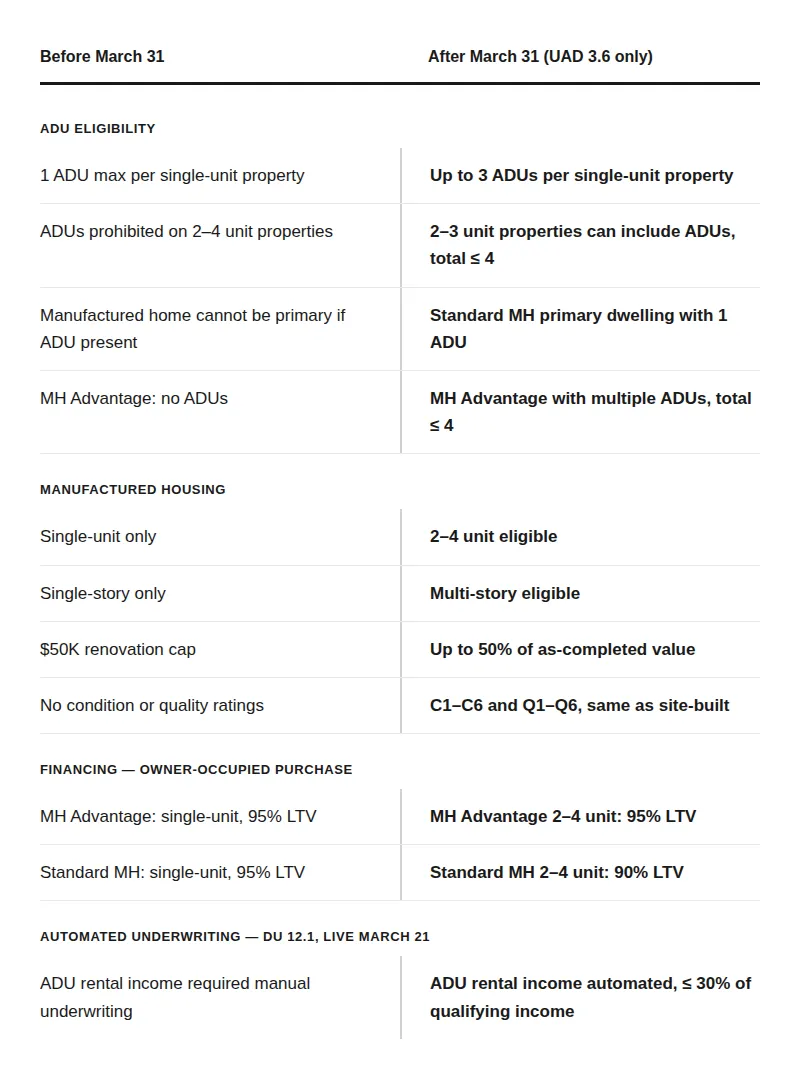
Sources: Fannie Mae SEL-2025-10, UAD 3.6 Policy Supplement, DU 12.1 Release Notes (Jan 28, 2026). All changes apply exclusively to lenders using UAD 3.6.
.The policy expansion is built on top of the data standard.
So what actually changed?
For 15 years, the data model behind over $1 trillion in annual mortgage volume could describe a three-bedroom ranch with perfect clarity, but couldn’t rate the condition of individual units in a duplex, verify whether an ADU had its own entrance, or rate the condition of a manufactured home. Every policy, every securitization, and every underwriting decision downstream of that limitation inherited it.
That limitation is gone. What gets built from here is a different question, but it won’t be decided by a 2011 data standard.