Why Builders Aren’t Building What Buyers Can Afford
By Peter Yoder. . 3 minute read.
Zoning is changing. The math hasn’t.
In much of the country, the economics of housing no longer align with the way homes are built. Mortgage rates remain elevated. Wages have grown, but not fast enough to keep pace with the cost of new construction. Many first-time buyers find themselves priced out of the single-family market, yet unwilling to rent indefinitely.
In response, many states have begun legalizing accessory dwelling units (ADUs) and duplexes on land once reserved for detached homes.
California’s SB 9 legalized duplexes and lot splits statewide in 2022. Oregon’s HB 2001 requires every city over 10,000 residents to allow duplexes, triplexes, and cottage clusters. Washington passed SB 5235 to eliminate ADU restrictions and HB 1110 to mandate fourplexes on most urban lots.
Montana and Utah now require cities to permit ADUs and duplexes by-right. Arizona’s HB 2720 obligates municipalities to allow backyard casitas. New England followed suit: Maine, Vermont, and Connecticut have enacted statewide duplex and ADU entitlements.
But one thing remains stubbornly unchanged: builders aren’t building them.
The zoning is changing. The math hasn’t.
Small multifamily housing has long occupied a strange middle ground in American real estate. Developers treat it like an investment. Consumers finance it like a home. That disconnect is now more visible than ever, as duplex-ready lots sit untouched.
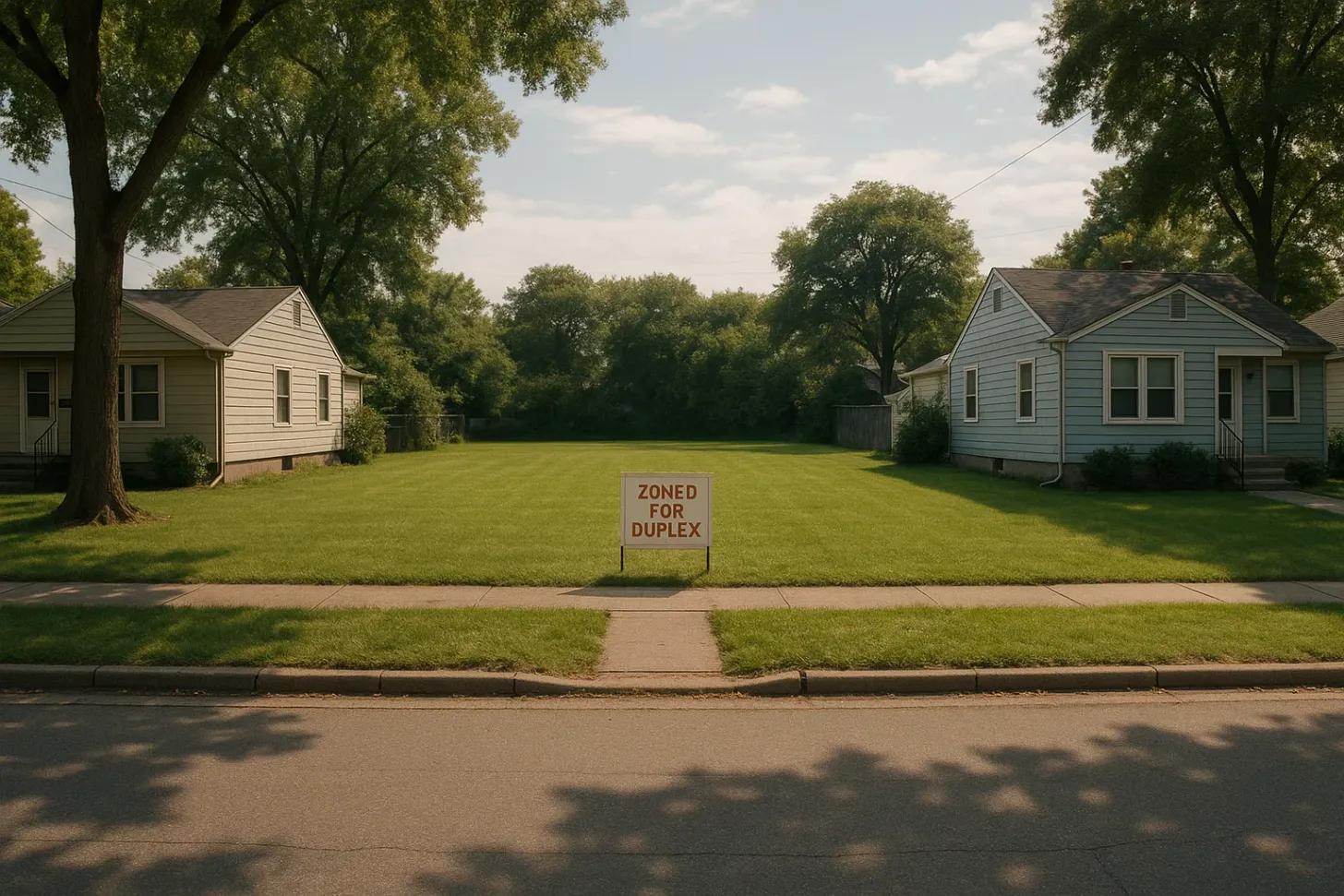
Builders, conditioned by decades of investor modeling, still underwrite these projects as rental properties: estimating gross rents, applying cap rates, and assessing whether the returns pencil.
But the most important buyer in this segment isn’t a landlord. It’s a first-time FHA-backed homeowner.
FHA financing allows a buyer to count 75% of the projected rent from a second unit, whether it’s a basement apartment or backyard ADU, as additional qualifying income. That rent isn’t deducted from their mortgage payment. It’s added to their income on paper. And that single distinction dramatically expands what they can afford.
Take a household earning $90,000 a year. Under standard debt-to-income rules, they might qualify for a $375,000 home. But if they purchase a property with an ADU expected to rent for $2,000 per month, FHA allows them to count $1,500 of that rent toward their income. That boosts their purchasing power to around $475,000, enough to close the gap between aspiration and access in many middle-income markets.
Yet this leverage almost never appears in land comps, feasibility models, or capital stack assumptions.
In cities where ADU and duplex construction is both legal and in demand, land entitled for two units still trades at a discount. Builders pass on these parcels not because there’s no buyer, but because they’re modeling the wrong one. The FHA borrower, whose buying power is enhanced by rent, is often more capable of closing than the investor the spreadsheet assumes.
So we see the pattern again. Policy opens the door. Buyers wait with financing in hand. Builders skip the lot. The housing never gets built.
There is no need for a new subsidy or a federal fix. FHA rules have supported small multifamily ownership since the early 1980s. Duplex loan limits now exceed $600,000 in most markets and reach over $1.5 million in high-cost metros. Zoning reforms are spreading. Construction margins can pencil if buyers’ actual financing power is factored in.
What’s missing is alignment. Developers, lenders, and capital partners are still using an outdated playbook, one built for investors, not for households using FHA loans and counting rental income to stretch their budget. A duplex is not a mini apartment building. Nor is it just a cheaper single-family home. It’s a different product entirely, and right now, it’s being overlooked not because demand isn’t there, but because the people building and financing homes are looking past the buyer who can actually afford it.