Homebuilders Are Solving for the Wrong Variable
By Peter Yoder. . 2 minute read.
Builders could solve affordability if they underwrote like lenders do.
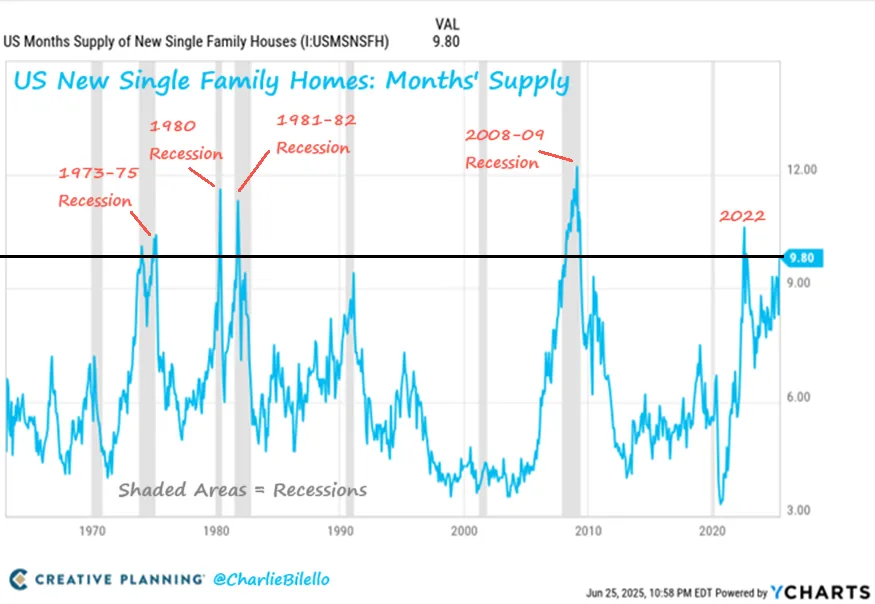
There are now over 500,000 new homes for sale in the US, the most since November 2007. Builders are still delivering inventory into a demand base that's been structurally altered by interest rates and affordability ceilings.
What builders call “absorption risk” is a qualification bottleneck. Many haven’t updated their models accordingly.
The dominant homebuilder approach remains the same in most Tier 2 and 3 markets across the country: deliver a single-family product at $250 per square foot, bake in a 15% net margin, and bring a 1,500-square-foot home to market at $431,250. At current interest rates, a borrower putting 5% down would face a $3,150 monthly housing cost. Standard 43% DTI underwriting implies that buyer needs to earn ~$92,000 per year.
As mortgage rates have risen, more buyers have fallen out of qualification range because the product hasn’t evolved to account for income constraints.
Meanwhile, builders have a second option they rarely consider: for the same 1,500 square feet, construct a duplex.
Duplex construction costs roughly 20% more per square foot: two kitchens, more complex fire and code compliance, and additional labor. That brings total cost to $450,000, and at the same 15% net margin, the sale price becomes $517,500.
At first glance, it looks riskier: higher cost, smaller buyer pool, harder financing.
But the math reverses when underwriting rules are applied properly.
At 5% down, the duplex costs about $3,800 per month to carry. But FHA, VA, and conventional underwriting guidelines allow buyers to count 75% of projected rental income toward qualifying income. Assuming a 6% return and allocating 30% for expenses, the second unit generates $1,295/month in net rental income.
The result: $2,505/month in net housing cost, 26% lower than the single-family home that sells for $86,000 less.
In real underwriting terms, the duplex requires less income to qualify, not more.
A duplex, or a home with a backyard ADU, is a balance sheet with levers. Owners can toggle between living and renting long term or short term on AirBnB, as owner occupiers compliantly skirt local restrictions against short term rentals by virtue of their occupancy.
These households have the optionality to rebalance between cost and income, and adapt to inflation, life changes, or job mobility.
Builders still think in square feet. Underwriters already think in income.
The limiting factor is nothing more than convention. Builders don’t model dual-unit yield. But if balance sheet protection is the priority, the logic is clear: the most financeable unit in the housing market is the one with two front doors.