Fractional Investment Platforms Sell the Illusion of Real Estate Wealth
By Peter Yoder. . 15 minute read.
What fractional real estate investing is actually selling, and what it can't.
"Democratize real estate." It shows up on every fractional platform's landing page, in every pitch deck, in every TechCrunch profile. The pitch is simple: 90% of millionaires have made their money from real estate, and historically, only wealthy investors could access those opportunities. You can't afford a house, so we'll slice one up and sell you a piece. The word “democratize” does a lot of heavy lifting by implying that the thing preventing renters from building wealth is access, and that a $100 minimum investment is the fix.
But there is a prior question nobody in this space seems to want to interrogate: what actually drives the wealth gap between homeowners and renters? Median homeowner net worth is $400,000. Median renter? $10,400. The Fed has tracked this since 1989 and the ratio has never dropped below 20:1.
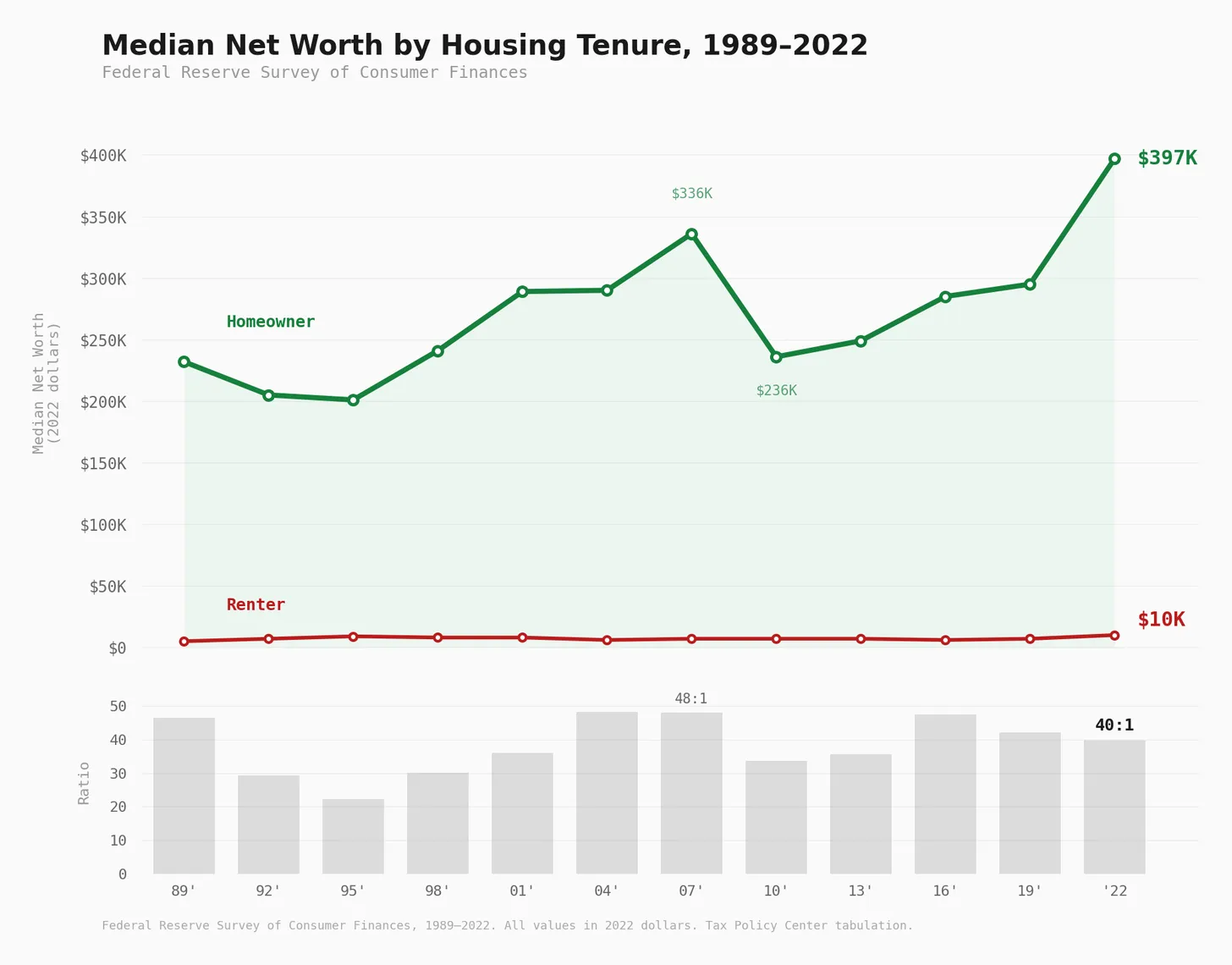
Let me make one thing very clear: a disciplined renter-investor with low housing costs and a systematic savings plan will build more wealth than a homeowner in an expensive market.
The problem is that person barely exists. So when people see the wealth gap and reach for explanations rooted in financial literacy or product exposure, they’re solving for the wrong variable. You could give every renter in America a brokerage account and a nudge and you’d move the needle a little. You could give them a mortgage and you’d change the structure of how their largest monthly expense interacts with their balance sheet.
Homeownership isn’t an investment. It’s a credible commitment between your present self and your future self. Present-you wants to spend. Future-you needs wealth. Every voluntary savings plan depends on present-you repeatedly choosing future-you’s interests, and the data says present-you loses that game almost every time. A mortgage changes the game by making defection catastrophic. You don’t save because you’re disciplined. You save because the alternative is losing your home. And it works precisely because you can’t opt out without destroying your shelter, your credit, and your equity in one move.
Platforms like Arrived, Fundrise, Lofty, and others let you invest $100 or $500 into shares of rental properties. Millions of people have signed up for these products. Arrived alone has over 946,000 registered investors. These are well run companies backed by the likes of Jeff Bezos and Marc Benioff.
And I think something important is getting lost in translation.
Let me start with what the products actually do.
Arrived, the most transparent platform in the space, allows you to buy shares in individual single-family rental homes. The company handles acquisitions, management, and dispositions in house. You collect dividends from net rental income. In Q2 and Q3 2025, average annualized dividends on their SFR properties ran around 4%. In October 2024, they sold their first property and reported an 11.2% annualized IRR on that deal.
Fundrise, the nation’s largest, currently manages $2.87 billion of equity on behalf of more than 385,000 individual investors. It’s Flagship Real Estate Fund has posted a 3.9% annualized return since inception, with $1.1B net asset value today.
The question I keep coming back to is whether what they do is the thing people think they’re getting when they sign up.
Here’s what I mean.
When someone puts $15,000 into Arrived, they’re usually not thinking “I want a 4% annualized dividend on a claim on net rental income from a single-family home in Charlotte.” They’re thinking about real estate wealth. They’re thinking about the thing their parents did, or their uncle, or their coworker — the person who bought rental properties and built something over twenty years. The marketing reinforces this. “Build your real estate portfolio.” “The wealth-building potential of owning rental homes.” “Financial freedom through real estate.”
But the economic structure underneath these products is fundamentally different from the thing that actually built your uncle’s wealth. And that difference matters more than I think most people realize.
It’s worth being honest about the fact that nobody has figured out how to make real estate returns easy, because it puts the fractional platforms in fairer context.
Take Blackstone’s BREIT, probably the gold standard of scaled real estate investing. This is a non-traded REIT sold through wealth advisors and holds over $100 billion in assets. They operate at roughly 50% LTV across the portfolio. Since inception, they’ve delivered a 9.3% annualized net return on Class I shares.
That 9.3% sounds fantastic. But here’s how it actually played out in real time: BREIT posted a -0.5% return in 2023 and less than 2% in 2024, before bouncing back to 8% in 2025. The 2024 10-K showed a $980 million net loss. When investors tried to exit in late 2022, Blackstone had to cap redemptions by limiting how much money could flow out each quarter. Those caps stayed in place until the end of 2023.
The reason BREIT survived is that Blackstone has a balance sheet large enough to absorb the losses and wait for recovery. Even the most sophisticated institutional manager on earth couldn’t engineer around that during a rate cycle. They just had enough capital to ride it out.
Then there’s Cadre, which tells an even more instructive story. Founded in 2014 by Ryan Williams and the Kushner brothers, Cadre was supposed to be the bridge between institutional real estate and the rest of us. Backed by Andreessen Horowitz, Thrive Capital, and Khosla Ventures, Goldman Sachs committed $250 million through a wealth management partnership. Forbes put them on the FinTech 50 seven years running.
The product genuinely worked. They let accredited investors pick individual commercial deals in multifamily, industrial, office, or hotels with a $50,000 minimum. Their investment team, staffed with institutional RE veterans, sourced and underwrote deals using proprietary data tools. Across nine fully-realized investments, they delivered an 18% average net IRR and returned roughly $300 million to investors. Their Sacramento multifamily deal nearly doubled investors’ money. On a deal-by-deal basis, you’d be hard pressed to find a better track record in the category.
But the business underneath the deals couldn’t sustain itself. Cadre’s revenue came from an annual management fee plus transaction and commitment fees on the assets they managed. That sounds like a viable model until you account for what it actually costs to run a tech-enabled institutional real estate platform: the investment team, the data science operation, the engineering, the compliance, the marketing, all at a scale that VC backers expected to grow exponentially. The cost of building and maintaining a tech platform for real estate investing exceeded what you can earn in management fees from the AUM that platform attracted. They couldn’t raise more capital and sold to Yieldstreet for an 87.5% discount from its peak valuation.
I think a lot about what it means that nobody has made scaled real estate intermediation work cleanly. Blackstone’s version works, but requires being Blackstone. Cadre’s version produced strong deals but couldn’t sustain the business that delivered them. And the fractional platforms are operating at even thinner margins with an even more constrained product.
Several have shut down entirely. Here, which offered fractional vacation rental investments, closed. LEX Markets, which partnered with Nasdaq to list fractional building shares, closed. Fintor raised $9 million for fractional residential, then abandoned it to become an AI mortgage operations company. Nada raised multiple rounds for city-level real estate index products, then pivoted to home equity access. PeerStreet, which raised $122 million for a real estate debt marketplace, went through Chapter 11 bankruptcy when less than half the $220 million loan portfolio was performing at filing. Landa raised $33 million in VC and took on roughly $60 million in debt to buy around 400 single-family homes in Atlanta. Investors could buy shares for as little as $5. When rates spiked in 2022, the margins between rent collected and debt service collapsed. By mid-2025, the app was offline, dividends had stopped, investors couldn’t access their accounts, and lenders were suing for $35 million in defaults. A court ordered 119 properties turned over to an independent manager.
The homes are still standing. They’re still worth something. But the investors’ claims on those homes run through an LLC structure, a startup’s solvency, and a bankruptcy court’s priorities. That’s not the same thing as your name on the deed.
Every one of these companies had smart people behind it who believed they were solving a real problem. And I think many of them were right about the problem, they were just wrong about the solution.
So if nobody's made intermediation work cleanly, what does work?
Here's the thing about real estate wealth: the mechanism that generates the returns isn't the asset. It's a financing structure that the federal government built for individual owner-occupants, and that structure doesn't survive fractionalization.
A household, every twelve months if they so choose, can put as little as 0-5% down through a VA, FHA, or conventional mortgage on a 1-4 family property and capture appreciation on 100% of the property. They lock a 30-year fixed rate: a product so unusual that almost no other country offers it to retail borrowers. They can deduct the mortgage interest, depreciate any investment portion of the structure while it appreciates in the market, and exclude up to $500,000 in gains at sale. And in the process, they convert their single largest monthly expense from consumption into equity. That’s not exposure to real estate. That’s a wealth-compounding machine with five distinct mechanisms working simultaneously, and the federal government subsidizes every single one of them.
Put $15,000 into a fractional SFR Fund. Prudent funds today target around 60% LTV, so your equity is backing roughly $2.50 in property for every dollar you invest. Give it every other advantage too: 5% annual appreciation on the underlying properties, 4% dividend yield. The levered appreciation flows through to your equity at about 12.5% annually. After five years you’ve made about $16,000. After ten, $44,500. After twenty, $189,000.
Now put the same $15,000 into an FHA duplex at 3.5% down. Live in one unit, rent the other at $1,700 a month. The rental income less operating expenses covers half your mortgage, so your net monthly housing cost is roughly what you'd pay in rent anyway. You just bought a $429,000 property at 28:1 leverage. Now make this person a worse investor. Give them 3.5% annual appreciation, 30% lower than the fractional platform’s rate. Even then: 3.5% appreciation on a $429,000 asset is $15,000 in year one. On $15,000 of equity, that’s a 100% return. The fractional investor’s 5% appreciation on $37,500 in levered property is $1,875.
After ten years, the worse-performing duplex owner has roughly $240,000 in equity from appreciation and principal paydown alone. The better-performing fractional investor has $44,500. After twenty, it’s $614,000 versus $189,000. Same $15,000 in. The duplex owner had a lower appreciation rate, no investment team, no data science, no platform. They still built five times the wealth at ten years, because 28:1 leverage on a government-subsidized fixed rate with tax benefits attached is a fundamentally different machine than 2.5:1 leverage inside a fee-bearing fund structure.
That’s not a difference in degree. It’s a difference in orbit. The mechanism isn’t comparable.
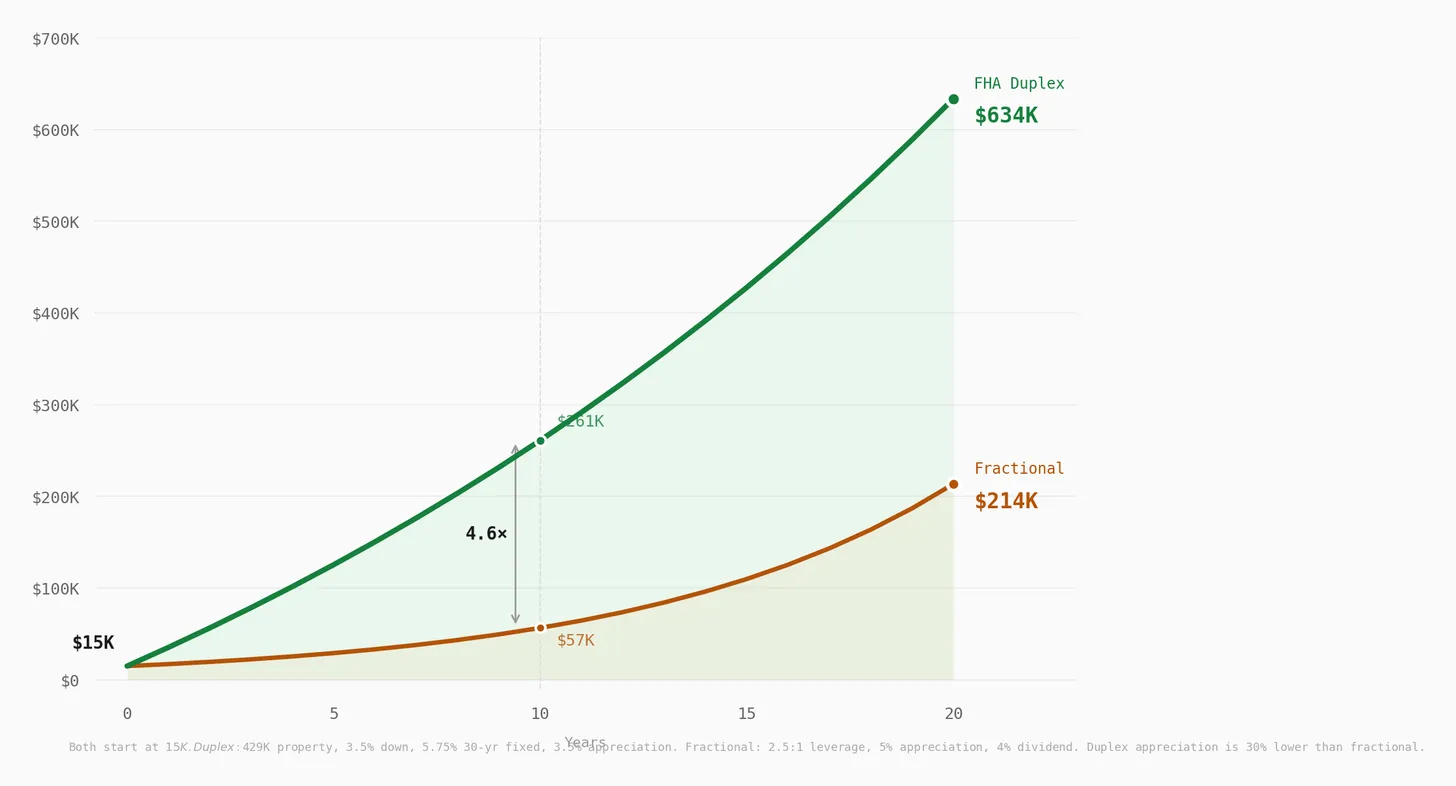
This isn't a “leverage is good” story. 28:1 leverage in any other context would be insane. A hedge fund running 28:1 would get a margin call within months (see LTCM). But an FHA mortgage isn't a margin loan. There's no mark-to-market. The property can drop 20% in value and the lender can't call the loan, can't reprice the rate, and can't demand additional collateral. The cost of capital is fixed for 30 years. The position can't be liquidated against your will as long as you make payments. And the payments themselves are fixed in nominal dollars, which means inflation works in the borrower's favor by shrinking the real cost of the debt every year. This is the only leveraged instrument in the American financial system where time and inflation are both on the borrower's side. The risk is employment, not market price, and the government has spent ninety years engineering the product to make that specific risk as manageable as possible.
None of this means the duplex path is easy or safe. It’s one property in one neighborhood with one or two tenants, and your name is on the debt. If you lose your job, the leverage that makes the math work can turn into real stress. You may deal with late rent payments, noise complaints, awkward hallway encounters. You give up flexibility. You’re not passive.
But that’s the point. The returns exist because the risk is real and the exposure is concentrated. Diversification makes things smoother, but it also makes outcomes average. Real wealth, by definition, comes from concentrated bets inside structures that amplify them. The owner-occupied model works not because it’s comfortable, but because it combines leverage, tax treatment, and concentration in a way most financial products don’t.
The fractional platforms strip out the work, and with it, the structure that generates the supernormal returns. Fractional platforms may pass through depreciation via its REIT structure, which reduces the taxable portion of dividends. But you can’t use that depreciation to offset other passive income. You don’t get the mortgage interest deduction or the primary residence capital gains exclusion. You don’t decide when to renovate, when to raise rents, when to refinance, or when to sell. Those are the decisions where real estate value is actually created.
If you own the property directly, the IRS lets you deduct up to $25K in rental losses against your W-2 income as long as your modified adjusted gross income is under $150K. That means your property can be cash-flow positive in real life while generating paper losses that reduce your tax bill on your paycheck. The tax code explicitly rewards you for putting your name on the deed, taking on the mortgage, and managing the property yourself. The more skin in the game, the better the tax treatment. The entire fractional pitch is "we'll remove all that friction for you," but in doing so they strip out the exact behaviors that compound wealth most effectively. Convenience is the product, but the cost of that convenience is losing the most powerful wealth-building tax benefits available to middle-income Americans.
I think a meaningful number of the people on these platforms are there because they believe this is their path into real estate wealth. And the part that bothers me is that a large portion of those people could actually qualify for an ordinary home loan on a duplex and access the actual wealth-building version of the thing they think they’re buying. But they don’t. And I’ve been trying to figure out why, honestly, because the answer isn’t as simple as I used to think.
The easy version of this argument is: nobody’s telling them about it. The fractional platforms have marketing teams and Instagram ads, and the 2-4 unit owner-occupied path has... nothing. No brand. No app. But it’s not the whole story, and if I stop there I’m being lazy.
The harder truth is that the owner-occupied multifamily path can’t be productized in the way that venture-backed technology companies need things to be productized.
And that’s a delivery problem.
Think about what it actually takes to get a first-time buyer into a duplex, triplex, or fourplex. You need a real estate agent who understands investment analysis on small multifamily, not just comps on single-family homes. Most agents don’t, because the volume of 2-4 unit owner occupied transactions is a tiny fraction of the residential market. You need a loan officer who knows the specific underwriting rules for 2-4 unit properties. Most loan officers have closed maybe four or five of these in their career, if any, because the training infrastructure barely exists. You need the buyer to walk through a property and understand not just “do I like this kitchen” but “what will this unit rent for and what are the operating expenses.” You need someone to teach them basic landlording before they close, not six months later when they’re already drowning.
Every step of that requires a human being with specific local knowledge sitting across from another human being and helping them make decisions that are genuinely scary. That’s the opposite of scalable. You can’t put it in an API. You can’t automate the part where someone looks at the numbers for the first time and says “I don’t know if I can do this” and needs somebody they trust to walk through the downside scenarios with them honestly.
And here’s the part I’m still wrestling with: fractional platforms exist precisely because this alternative is so hard to deliver. The owner-occupant, name on title, personal balance sheet risk path resists every tool that technology companies have. It requires local expertise that doesn’t generalize. It requires hand-holding that doesn’t scale. It requires a business model built on low-volume, high-touch transactions in a world where VCs want high-volume, low-touch products. The 2-4 unit owner-occupied model is an incredible wealth-building tool. It is also, from a business-building perspective, a nightmare to deliver consistently across markets.
So I understand why the fractional path is winning. It’s packageable. It fits in an app. It scales. The problem is that winning on deliverability doesn’t mean winning on outcomes. The thing that’s easy to build and sell is not the thing that actually works the best for the person buying it. And that gap is, I think, the central tension of this entire space.
What I keep coming back to is the question of what would actually help.
The housing affordability crisis in America is not a shortage of investment exposure to residential real estate. You can get that from a REIT index fund for a 0.12% expense ratio with full daily liquidity. If passive real estate exposure is all you want, it’s already fully democratized.
People can’t get into homeownership because they can’t accumulate the down payment, can’t navigate the mortgage process, can’t find the right property, can’t figure out how to make the numbers work on a 2-4 unit building when they’ve never been a landlord before. Those are real barriers. But they’re barriers of navigation and confidence, not barriers of product design, and the difference matters. You solve navigation barriers with human expertise and institutional support. You solve product design barriers with technology. The fractional platforms applied a product design solution to a navigation problem, and that’s why the results look the way they do.
The 2-4 unit owner-occupied model is a specific, proven answer to the navigation problem. It’s how a huge portion of the existing small multifamily stock in Boston, Chicago, Brooklyn, and Philadelphia was originally built by owner-operaters. It’s been explicitly supported by FHA, VA, and conventional loan programs for 60+ years. The infrastructure already exists. But the connective tissue — helping buyers find the right properties, connecting them with the lenders who actually know this product, teaching them to manage tenants — is extraordinarily hard to build. It requires people, not platforms. It requires the kind of patient, slow-growth business building that venture capital isn’t designed to fund.
I want to close with a disclosure that matters.
I run a fintech company that helps owner-occupants purchase 2-4 unit properties. I am not a disinterested observer. I have a direct business interest in people choosing owner-occupied multifamily over fractional platforms. You should weight everything I’ve written here accordingly.
I’ve tried to let the data do most of the talking. But I’d be lying if I said my perspective wasn’t shaped by the fact that I spend my days working with people who are doing the hard version — qualifying for the loan, finding the property, learning to be a landlord — and watching it change their financial trajectory in ways that a 4% annual dividend on a $15,000 investment never will.
What I’m less sure about is what to do with that observation. The fractional platforms are here to stay. And the alternative is genuinely hard to deliver. It’s hard to scale, hard to systematize, hard to fund. I don’t have a clean solution to that. I just think it matters that people understand what the economic structure underneath the product actually looks like compared to the thing they think they’re accessing.
Maybe just naming the gap clearly is useful. I don’t know. But I think the conversation is worth having, and I’d rather have it with all my biases on the table than not have it at all.