Homeownership Has a Productivity Problem
By Peter Yoder. . 2 minute read.
Homes Aren't Expensive. Dead Assets Are.
Every mortgage is a bet. The lender bets that the borrower will be able to make their payment next month, and the month after, and the month after that, for 360 months. The borrower bets that the home will be worth at least what they paid for it.
The way the lender sets the ceiling on that bet is by looking at your income, debts, and applying a ratio. Your total monthly debt payments, including your housing payment, typically can’t exceed 43% of your gross monthly income. That ceiling determines the maximum loan you can get, which determines the maximum home you can buy.
For a single-family home, your income is the only variable that matters. The equation is:
max purchase price = f(your income, the interest rate)
But there’s a variable hiding in the equation. A home can produce income.
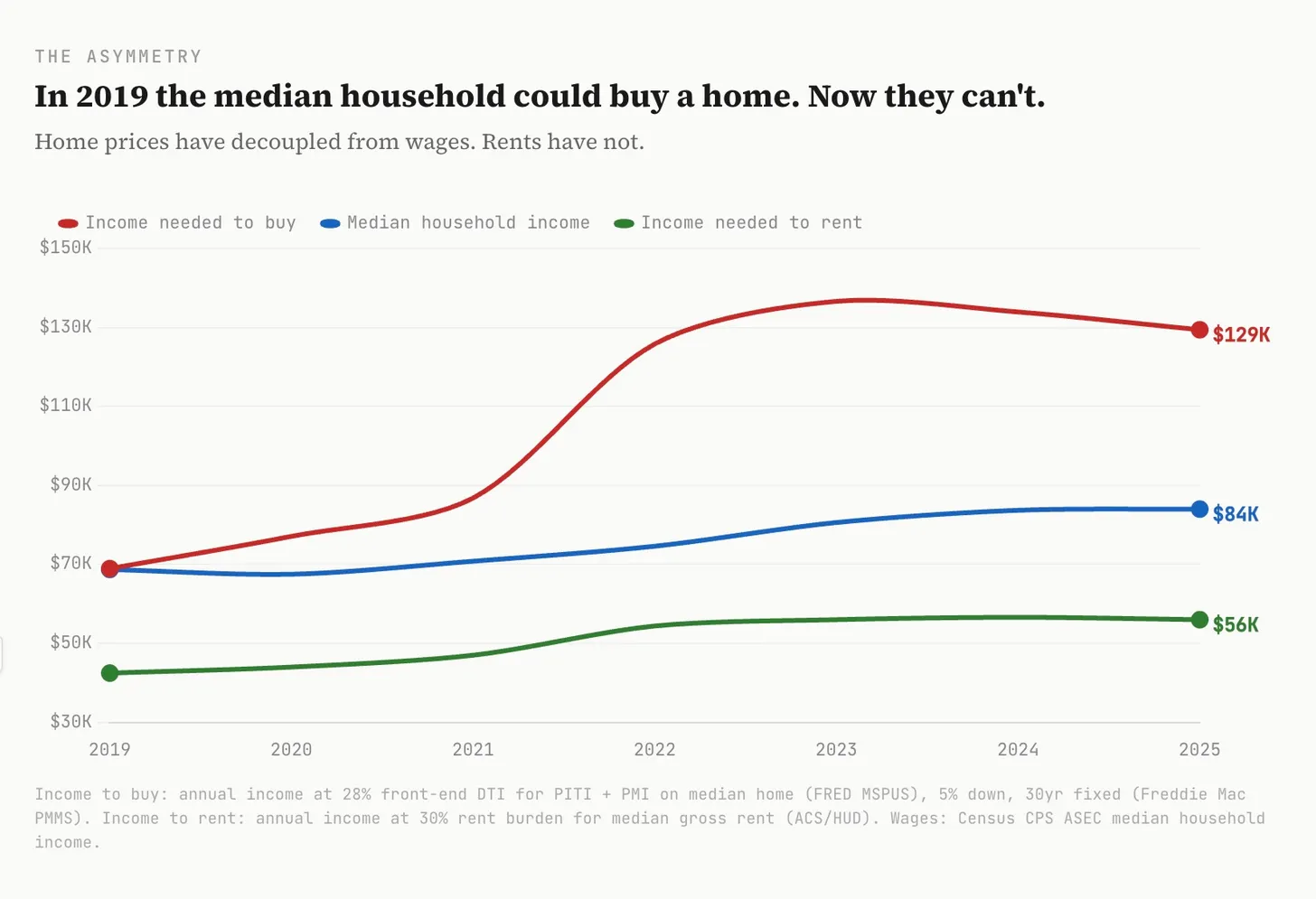
Rents are marked to market annually against wages. Home prices are marked to market once a decade against borrowing capacity.
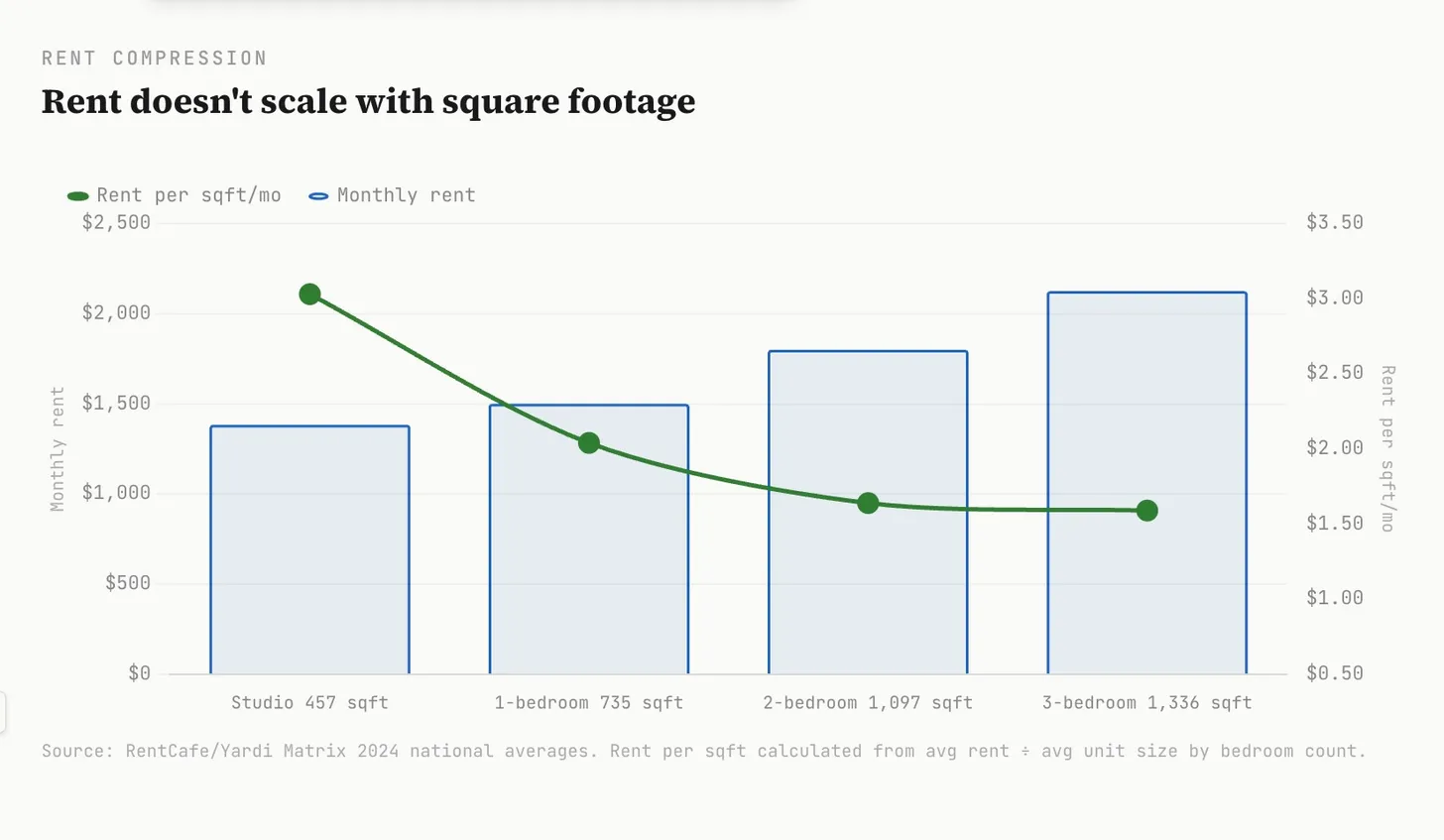
Rent is inelastic to square footage. A unit that is 75% smaller does not rent for 75% less. It rents for 35-50% less. The gap between the reduction in space and the reduction in rent exists because rent prices a bundle of things that don’t scale with square footage: a legal address, a private entrance, a kitchen, and a bathroom.
Because rent compresses less than space, total revenue per square foot of structure increases with unit count.
A home with a backyard ADU has two units. A triplex has three. A fourplex has four. The rent is a second source of debt service. The new equation is:
max purchase price = f(your income + the property’s income, the rate)
Here’s what that looks like in practice. A household earning $100,000 a year, today’s mortgage rate of 6.3%, 5% down on a conventional loan. No rental income versus qualifying with 75% of projected rent from the other units.
Even for the same household with the same income, the ceiling moves by $167,000 because the property itself generates qualifying income.
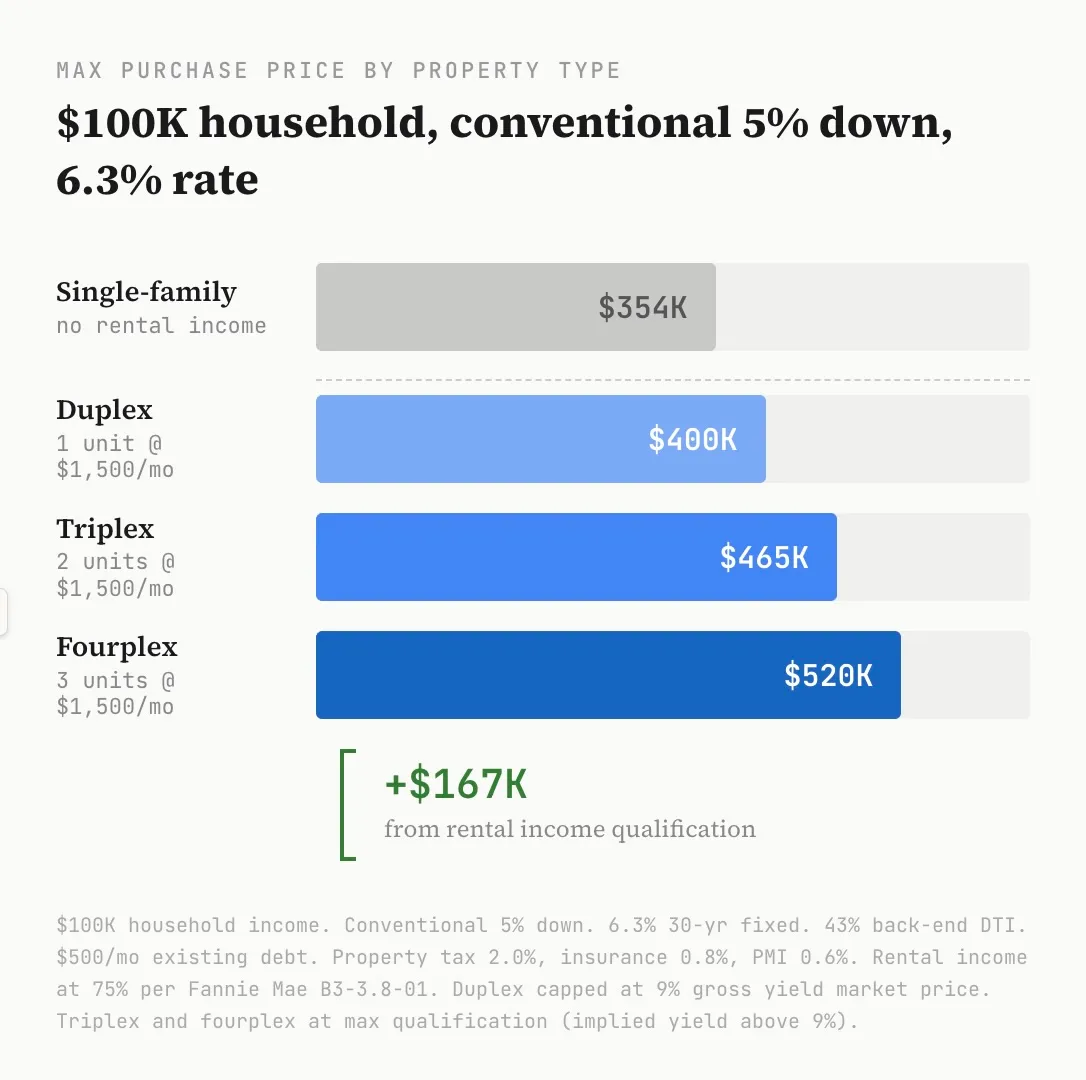
The unit premium is anchored to wages while the thing it's offsetting, the purchase price, is the thing that's broken loose. The more units, the more wage-anchored income streams, the more coverage.
Rent is how the starter home was financed before zoning codes or 30-year mortgages existed. After 1945, duplexes, triplexes, and quadplexes got zoned out of existence and no new middle-income housing took their place.
Policy debate has been organized around a false axis: renting vs. owning. That framing treats them as opposites: you’re either on one side or the other. Rent and ownership are complementary inputs in the same equation.
Interest rates are set by the Fed. Down payment requirements are set by GSE policy. The borrower controls almost nothing in the affordability equation. Rental income is the one variable that still tracks what people actually earn, what they can actually pay monthly. It’s the last honest number in the stack.
Prices aren’t the disease. The absence of productive capacity in the asset is. A home that generates no income is a dead asset. A home that generates income is infrastructure. We functionally eliminated the productive residential asset from the owner-occupied market and then spent 80 years wondering why homeownership attainment keeps getting worse.