Is the Duplex the New Starter Home?
By Peter Yoder. . 3 minute read.
Why owner-occupants now outbid investors on leverage, not price.
The entry point into American homeownership has shifted, and few have noticed.
For most of the postwar era, first-time homebuyers followed a familiar path: save for a down payment, qualify for a fixed-rate mortgage, buy a modest single-family home, and begin building equity. The model worked because the cost of entry aligned with the structure of middle-income wages.
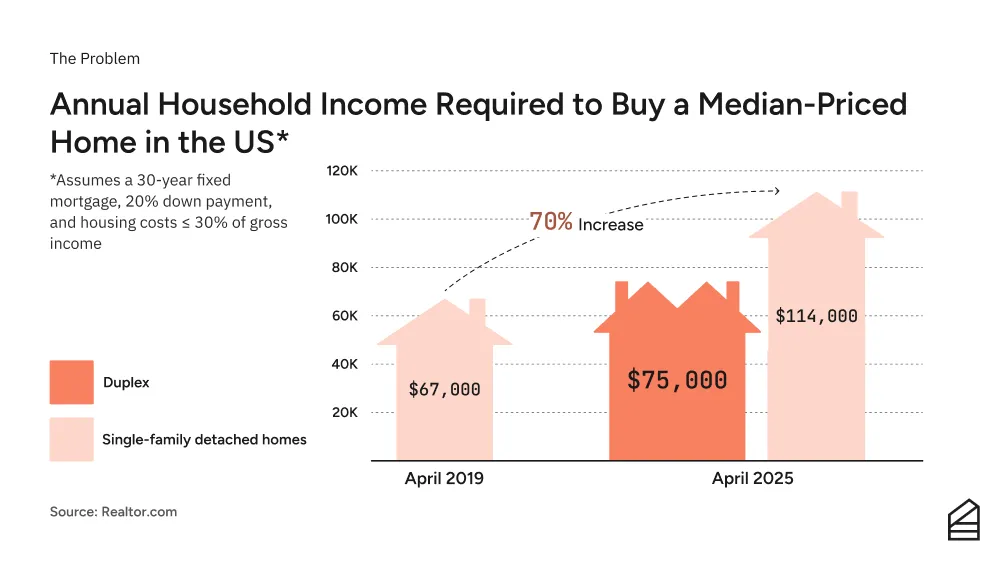
But in 2025, that alignment has vanished. According to recent national data, the median U.S. home price is now $422,300, which requires a salary of $112,486 to afford under conventional lending standards. In high-demand metros like Denver, Boston, and San Diego, that income threshold jumps to $155,000 or more. The “starter home” has become a financial contradiction: something too expensive to start with.
As a result, buyers are quietly disengaging. Incomes haven’t kept pace, and the platforms designed to help navigate the market, Zillow, Redfin, et al, do little more than showcase sticker prices with no reference to what a buyer actually qualifies for.
Credit is available, but opaque. The result is a growing class of Americans who are technically mortgage-eligible, but structurally excluded.
And yet, buried in federal lending policy, an overlooked pathway still exists.
Under current FHA, VA, and conforming loan rules, a buyer can purchase a two, three, or four-unit property, and still qualify for a primary residence loan, as long as they live in one of the units.
These programs allow down payments as low as 3.5%, 30-year fixed rates, and, crucially, let 75% of projected rent from the additional units count toward income when determining loan eligibility.
In practice, this means a $420,000 duplex may be more affordable than a $350,000 single-family home. The buyer doesn’t need to be a landlord. They don’t need an LLC. They just need to live in the home and follow standard underwriting. The asset becomes self-supporting in a way no single-family purchase can be.
In Indianapolis, where a single-family home now requires a salary of $82,000 to finance, the addition of rental income from a second unit can drop the income requirement to the mid-$50,000s. In Atlanta, the delta is closer to $25,000. In Denver, where the median price is now over $675,000, the difference can mean the ability to qualify, or not at all.
This is, by design, the most consumer-friendly credit structure left in the housing market. And almost no one is using it.
The reasons are not surprising. Zillow doesn’t filter for rent-backed qualification. Listings rarely include projected rental income. Agents are trained to serve traditional transactions, not structure income offsets. And lenders are often brought in too late to reframe the search. In most cases, buyers never even learn that this financing path exists, let alone see inventory aligned with it.
Meanwhile, 2–4 unit properties are sitting. Listings now spend 161% longer on market than in 2021. The investor buyer pool has pulled back due to compressed cap rates and rising rates. Institutional buyers avoid sub-scale assets. And yet the segment remains well within the boundaries of government-backed lending.
What’s missing is not demand. According to a 2023 survey by the Center for Housing Technology Research, over half of Millennials and Gen Z buyers say it is “very important” to be able to rent out part of their home while living in it. The idea isn’t new. It’s just been stranded between consumer intent and institutional clarity.
In short, the financing exists. The inventory exists. But the system hasn’t connected the two. And the result is a mispriced, underutilized, and increasingly relevant slice of the American housing market.
A generation ago, the starter home was a 1,200-square-foot ranch on the edge of town. Today, it might be a small multifamily property, where one unit covers 35% of the mortgage, the buyer builds equity, and the entry point actually matches the economics of work.
But for that shift to happen, the market needs new infrastructure. Not new rules, those already exist, but new pathways to make the rules usable. Platforms that surface only what buyers can qualify for. Listings that price monthly cost after rent. Transactions that respect federal compliance and buyer solvency from day one.
The duplex is a reflection of policy that was always meant to enable ownership for working people. And if done right, it might just be the most viable starter home left in the American housing system.