The Zillow–Compass fight is Over an Experiment That Already Ran
By Peter Yoder. . 5 minute read.
We treat the MLS as the definitive, objective ledger of American real estate, but the 2–4 unit segment proves it suffers from severe survivorship bias.
On a Friday in May, thousands of Chicago homes abruptly vanished from Zillow. The regional multiple listing service had cut the portal’s feed, prompting a federal judge to restore it two days later. Zillow had sued the multiple listing service and Compass, the nation’s largest brokerage, for conspiring to threaten its access to listings. Compass had previously sued Zillow over its refusal to display homes marketed in private before reaching the public exchange. The matter now sits quietly under advisement in a federal courtroom.
The lawyers frame this battle as a contest over consumer transparency. But what is actually on trial in Chicago is a fundamental problem of mechanism design. Zillow’s executives argue that private listing networks hurt everyone. Compass’s executives counter that homeowners should have the right to test prices quietly.
They are arguing from theory. But they do not have to, because the experiment they are debating has been running for decades in a corner of the housing market almost nobody watches. The country’s $3 trillion worth of duplexes, triplexes, and fourplexes represent a multi-decade case study in game theory and adverse selection.
This small multifamily segment never had a rule forcing its trades into the light. The majority of its transactions happen in private. And the record of what happens to the trades that do reach the public exchange provides the clearest evidence in existence of what a housing market becomes when its volume goes dark.
The Multiple Listing Service is Not Really a Market
A stock exchange is a two sided mechanism where bids and asks collide to discover a clearing price. The multiple listing service is a shared database owned by local Realtor associations. It is entirely one sided. Sellers post asking prices. That’s it.
The system records initial asks and final closings. It leaves absolutely no trace of the rejected offer, the buyer who ran a discounted cash flow model and walked away, or the investor who found the cap rate absurd and never called.
In economic terms, this creates an environment of catastrophic information asymmetry. Look at what this design does to a seller of a small building in Austin, Texas.
Over six months this year, Travis County recorded 175 closed on market sales of 2-4 unit properties. In that same window, 194 listings on the MLS expired or were withdrawn without a sale.
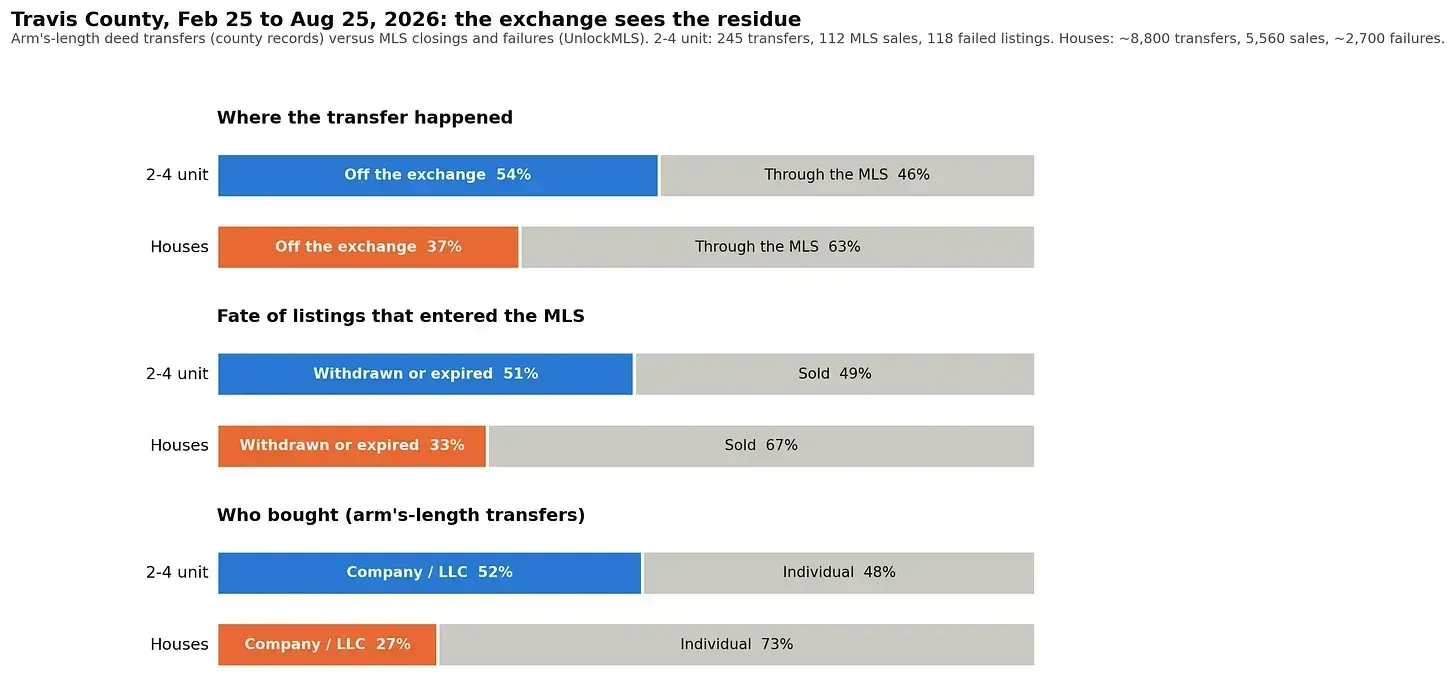
While 70% of detached single family houses sold, fewer than 50% of the small multifamily buildings did. The sellers failed because the public exchange is structurally incapable of transmitting complex information. The median Travis County small building sold for $450,000, bringing in about $40,800 a year in rent. After Texas property taxes, insurance, vacancy, and upkeep, the building nets about $18,500. For an investor borrowing at current rates, the debt service vastly outpaces the income. The actual price at which that income supports a standard loan is roughly $287,000.
The seller and the only buyer requiring bank financing are a third apart. But the venue has no mechanism to say the price is 33% too high. So the seller cuts the price by six percent and waits, then cuts another six percent and waits, slowly failing in public.
What we are witnessing here is a classic separating equilibrium. True price discovery happens in the dark. County deed records reveal that at most 46% of small buildings that changed hands did so through the public database. The rest traded in a private, high bandwidth network of investors buying from investors, where prices are negotiated via spreadsheets.
That private market has bids that clear. When the good assets clear privately among informed actors, the public venue becomes a dumping ground for overpriced assets that the private network already evaluated and rejected.
The Data Hallucination
This dynamic reaches far beyond the duplex. The multiple listing service was built as a broker inventory tool, but it has accidentally become the public record of American housing prices. The comparable sales that set appraisals, the algorithmic valuations seen by millions on portals, the price indices monitored by the Federal Reserve, they all assume the database sees the entire market.
Consider the favorite metric of the real estate industry. Days on market. In Austin, the median days on market for the small 2-4 unit buildings that sold was 40 days. For single family houses, it was also 40 days. Because the figure only counts listings that actually sold, a market where half the listings die looks statistically identical to a market where nearly all of them close. It is a textbook case of survivorship bias built directly into a macroeconomic ledger.
If you build an automated valuation model using the minority of duplexes that actually traded on the exchange, you are not reporting what the market knows. You are reporting what the leftovers know. Real estate liquidity is not a fixed ontological property of a building. It is a property of the pairing between a building and a venue.
If the rule forcing single family homes onto the public exchange is removed, or if private networks siphon off half the volume, the broader housing market will produce the exact same hallucination. We will have a public record that describes only the leftovers, and a set of national institutions mistaking those leftovers for reality.
The Mechanism Design Failure
This structural failure completely undermines the most celebrated housing policy of our generation. Cities across the country have reformed zoning to legalize missing middle housing, promising that households priced out of single family homes will finally be able to buy a duplex or triplex.
This policy assumes that if you build it, the market will naturally allocate it to the middle class.
A small building sold whole is a complex income asset. 52% percent of the arm’s length purchasers in Travis County were LLCs or investor trusts. They trade in networks that a standard household cannot enter. The conventional consumer mortgage system, built for single family consumption, stretches to its breaking point when underwriting a duplex.
There is only one reliable path by which a small building reaches a family on the public market. A developer records a condominium declaration, legally fracturing the building into separate units, and sells each side as a residential condo on an ordinary mortgage. The market does not adapt the venue to the asset. It completely destroys the asset to make it fit the venue.
Zoning reform creates the legal right to build, but it completely ignores mechanism design. By legalizing triplexes on single family lots without fixing the point-of-sale, we have simply legalized investor rental stock, held by corporate entities, traded in private networks, and priced in the dark.
The courtroom fight in Chicago is a battle between a portal that needs the database complete to sell ads, and a brokerage that needs it fractured to sell access. They are both arguing for their own interests. But the rest of us are left relying on a macroeconomic hallucination. Until the public ledger is forced to see the truth, the American housing exchange will remain exactly what the duplex proves it to be: a private clearinghouse for the wealthy, and a public remainder bin for everyone else.