The Asset Class Built on a Missing Buyer
By Peter Yoder. . 4 minute read.
How distribution failure in mortgage origination abandoned the country's most pro-middle class housing stock
Earlier in my career I was managing acquisitions for a mid-market housing rental fund. We were looking at a 78-unit deal in Florida. It was marketed as a multifamily portfolio, priced like one, and packaged like one. I started due diligence and realized what we were actually analyzing: thirteen duplexes and thirteen fourplexes. Twenty-six small buildings scattered across a submarket, dressed up in aggregate as something institutional capital could underwrite.
We bought it at close to $115,000 a door.
So why were we the ones buying it?
The highest-value buyer for these buildings wasn’t in the market. The inventory had nowhere to go. It accumulated, got packaged, and landed on my desk. There is a graveyard of retail market failure beneath the institutional small multifamily trade, and it has been filling up for decades.
Take one of those fourplexes. $460,000 asset. Three tenants paying $1,000 a month offset most of the mortgage. An individual homebuyer putting 5% down through a Fannie Mae product can own it for less than what they’d pay to rent the same unit. That buyer can outbid us. The math works better for them than it did for us.
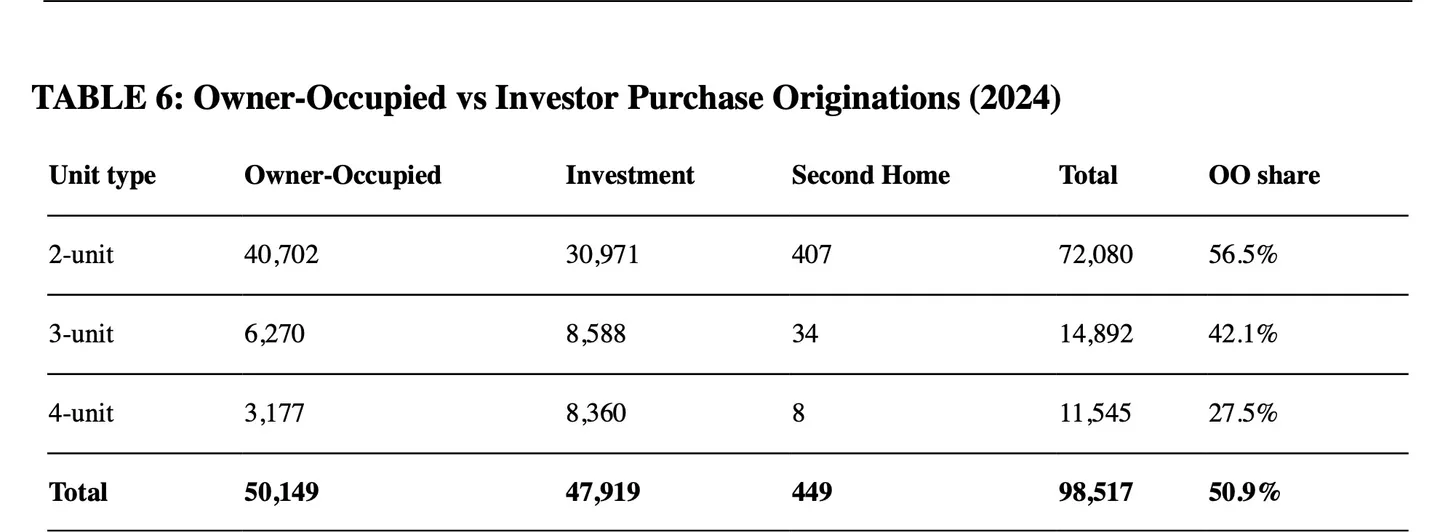
I pulled purchase origination data directly from the Federal Financial Institutions Examination Council database. In 2021, the most active purchase market in a generation, 5.4 million owner-occupied purchase mortgages originated 1-4 family properties. 2-4 unit properties accounted for 71,572 of them. 1.5% of the market. Then rates rose, volume collapsed, and 2023 produced 3.4 million owner-occupied purchase 1-4 family originations. 2-4 unit properties accounted for 46,956. Still 1.4% of the market.
Through a roaring low-rate boom and a punishing high-rate contraction, the owner-occupant buyer for this product class is absent at almost exactly the same level of absence. The asset class represents roughly 7% of the national housing stock. The financing gap is more than 5 to 1.
The financing products that would serve this buyer have existed for several decades. FHA, VA, and conventional programs allow lenders to count 75% of future rental income toward qualification and get buyers into these buildings with 0-5% down. The demand should be there.
What’s missing is distribution.
Loan officers and real estate agents whose pipelines run on single-family volume have no structural reason to master a transaction type that requires different income calculations, different appraisal methodology, and different borrower education. The automated underwriting tools that transformed single-family lending over the last decade — desktop appraisals, automated income validation, streamlined AUS decisions — exclude 2-4 unit properties by design. The assembly line was built for one product. Everything else is a workaround. So the buildings kept accumulating. And eventually they landed on desks like mine.
Here is why this matters to investors in this space.
The investor thesis for small multifamily is built on acquisition economics that are a product of retail failure. Thin transaction volume means thin comps. Thin comps mean appraisers discount for uncertainty. Valuations are structurally below where they’d be in a functioning market. That’s good for acquirers today. It is a problem for everyone at exit.
The most liquid exit for individual 2-4 unit assets has always been the owner-occupant buyer. Investor to investor secondary markets for small multifamily are thin. If the retail buyer remains as absent as the data show, the exit for the aggregation trade is constrained in ways that don’t show up in today’s underwriting but will matter when it’s time to sell.
Single family rentals institutionalized because retail volume created comps, comps supported appraisals, appraisals supported valuations, and valuations attracted capital. The flywheel started with transaction volume. Small multifamily’s retail side has been running at 20% of its natural volume for decades.
Building the retail buyer is not charity. It is the transaction volume the asset class needs to price itself correctly. The investor solving for yield and the company solving origination distribution are working the same problem from different ends.
My company, Series Homes, originates FHA, VA, and conventional loans for owner-occupant buyers of 2-4 unit properties. We work through residential agents in markets with 2-4 unit stock and train them to make these transactions work for retail, primary residence buyers. The infrastructure we’re building doesn’t exist at any real scale yet.
The sellers those buyers are buying from are the generation of people who purchased these buildings the old way: young, owner-occupied, rental income covering the mortgage. They’re in their sixties and seventies now. When they sell, these buildings are going somewhere.
Right now they’re mostly going to yield-seeking investors. The data are clear on what happens next: thin comps, constrained exits, an asset class that cannot fully price itself because the retail market never showed up.
That’s the trade Series Homes is making. Not against the institutional capital already in this space, but alongside it. The retail buyer is what re-rates the asset class. We’re building the infrastructure to put them in the market.