How Dodd Frank Strangled the Missing Middle
By Peter Yoder. . 2 minute read.
2008 Was a Financial Crisis. The Fourplex Became a Regulatory Casualty.
Between 2009 and 2019, single-family housing starts recovered from 445,000 to over 1.2 million annually. Starts in buildings with five or more units recovered from 97,000 to over 370,000. Starts in 2-4 unit buildings did not recover. They remained in the range of 10,000 to 15,000 per year, roughly one-tenth of the levels sustained through the 1970s and 1980s, when the country routinely started 100,000 or more 2-4 unit housing units annually. Over the full decade of the 2010s, total 2-4 unit starts were approximately 123,000, which the country exceeded in 1973 alone.
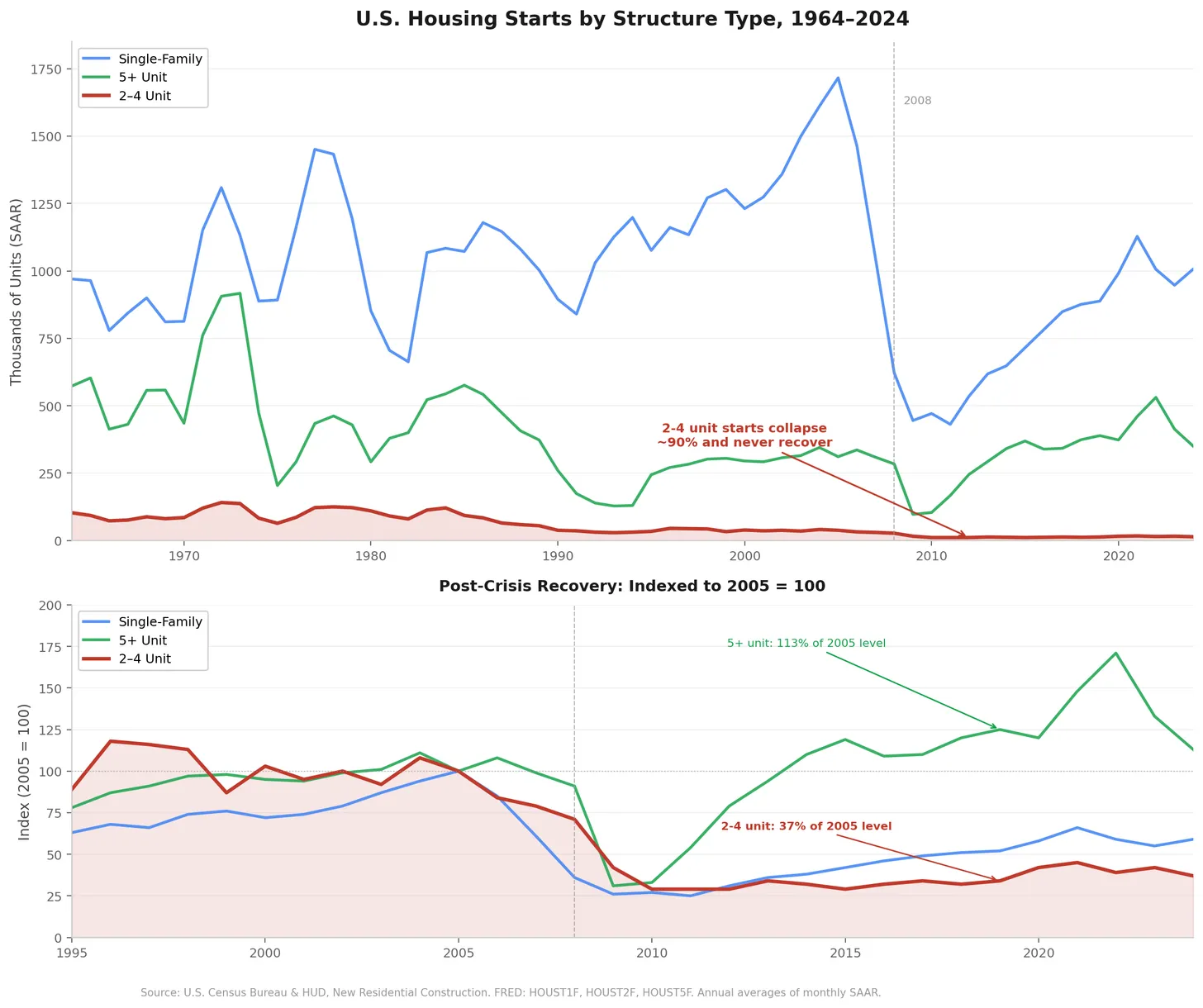
This is the sharpest sustained divergence in American residential construction data. And it demands explanation, because the three segments do not face identical constraints.
Single-family and 2-4 unit properties are both financed through the residential mortgage system governed by Dodd-Frank, the QM rule, GSE guidelines, and FHA/VA program requirements. Properties with five or more units are financed through commercial lending channels like CMBS, bank portfolio loans, and agency multifamily programs (Fannie Mae DUS, Freddie Mac Optigo) that operate under a different regulatory framework entirely.
This creates a natural experiment, albeit an imperfect one. The 5+ unit segment and the 2-4 unit segment overlap in their exposure to local zoning, land use, and entitlement constraints. They diverge in their exposure to residential mortgage regulation. The segment financed through the residential system failed to recover. The segment financed through the commercial system did.
This does not prove that financing is the sole or even primary explanation for the divergence. Construction economics differ between the two segments. Developer types differ. Labor markets, material costs, and economies of scale all favor larger projects. Zoning may also bind differently: some jurisdictions permit 5+ unit construction by-right in zones where 2-4 unit buildings require variances or conditional use permits.
But the financing channel difference is the most structurally distinct variable between the two segments, and it has received the least attention in the housing supply debate. The hypothesis that residential mortgage regulation is a significant contributor to the 2-4 unit construction collapse has not, to my knowledge, been formally tested. The divergence in recovery trajectories is consistent with this hypothesis and inconsistent with explanations that rely solely on zoning.
It is worth stating plainly: the housing policy field has invested enormous analytical energy in quantifying the effect of zoning on housing supply. It has invested comparatively little in quantifying the effect of mortgage regulation on housing supply, particularly for the 2-4 unit segment that sits at the intersection of the two systems.
The country has a proven housing typology that simultaneously creates supply, builds wealth for moderate-income households, and pencils without subsidy, and the policy apparatus ignores it because financing policy and housing supply policy don’t talk to each other.